Mini Facelift vs Full Facelift: Who Is a Short-Scar Lift Enough For?
- At AVA, a mini facelift maintains the same deep sub-SMAS dissection extent as a full facelift while using a shorter skin incision.
- A shorter skin incision limits the amount of excess skin that can be removed and the extent of neck skin redraping; neck laxity and skin redundancy guide selection.
- The term mini facelift varies between clinics. Confirm the actual dissection plane and extent, skin incision design and treatment of the neck. For travel planning, a mini facelift (11–12 day Seoul stay) and full facelift (11–14 day stay) both involve suture removal on postoperative day 10 at AVA.
Planning a facelift in Seoul? Explore our Facelift in Korea: surgery, recovery and before-and-after cases.
Mini Facelift vs Full Facelift: Who Is a Short-Scar Mini Lift Enough For?

"Would a mini facelift with a shorter incision be enough for me, or do I need a full facelift?" This is one of the most frequent questions I hear in the consultation room. When considering scars and recovery time, it is completely natural to look into a smaller procedure first.
In short, AVA Plastic Surgery's mini facelift maintains the exact same sub-SMAS deep dissection extent as a full facelift while shortening only the skin incision—running from below the sideburn along the front of the ear to just behind the lower earlobe—making it ideal for patients whose sagging is focused in the cheeks, mouth corners, and mild jowls with minimal neck laxity or excess skin [1][2]. When pronounced jowls and loose neck skin are present, however, a full facelift incision extending behind the ear is required to redrape the neck skin properly [2][3]. Here are the anatomical criteria we use to decide between a mini facelift and a full facelift.
What Does "Mini" Actually Mean in a Mini Facelift?
Because the term "mini facelift" is used by different clinics to describe everything from skin-only tightening to deep SMAS procedures, you should always check which anatomical layer is dissected and how far, rather than relying on the name alone [1][2].
At AVA Plastic Surgery, a mini facelift uses the same extent of dissection beneath the SMAS layer as a standard full facelift, designing only the skin incision to be shorter. In other words, the internal lifting work is not smaller—only the length of the skin incision is reduced. So what changes when the skin incision is shorter?
What Can and Cannot Be Achieved Through a Short Skin Incision?
A facelift skin incision serves two distinct purposes: (1) providing surgical access to the deeper SMAS layer, and (2) trimming and redraping excess skin after the deep tissues have been elevated [1].
1. Repositioning the Deep Layers (Sub-SMAS): Because the extent of sub-SMAS dissection is the same, lifting the sagging mid- and lower-face structural tissues can be performed just as thoroughly as in a full facelift [1].
2. Trimming Excess Facial Skin: A shorter skin incision limits both the amount of excess skin that can be excised and the vector of redraping. Forcing a large amount of redundant skin into a short incision can cause skin bunching (pleating) around the ear or place excessive tension on the scar [1][2].
3. Redraping Loose Neck Skin: Redundant neck skin is primarily redraped upward and backward through the retroauricular incision behind the ear. Without this posterior extension, loose neck skin cannot be adequately repositioned [2][3].
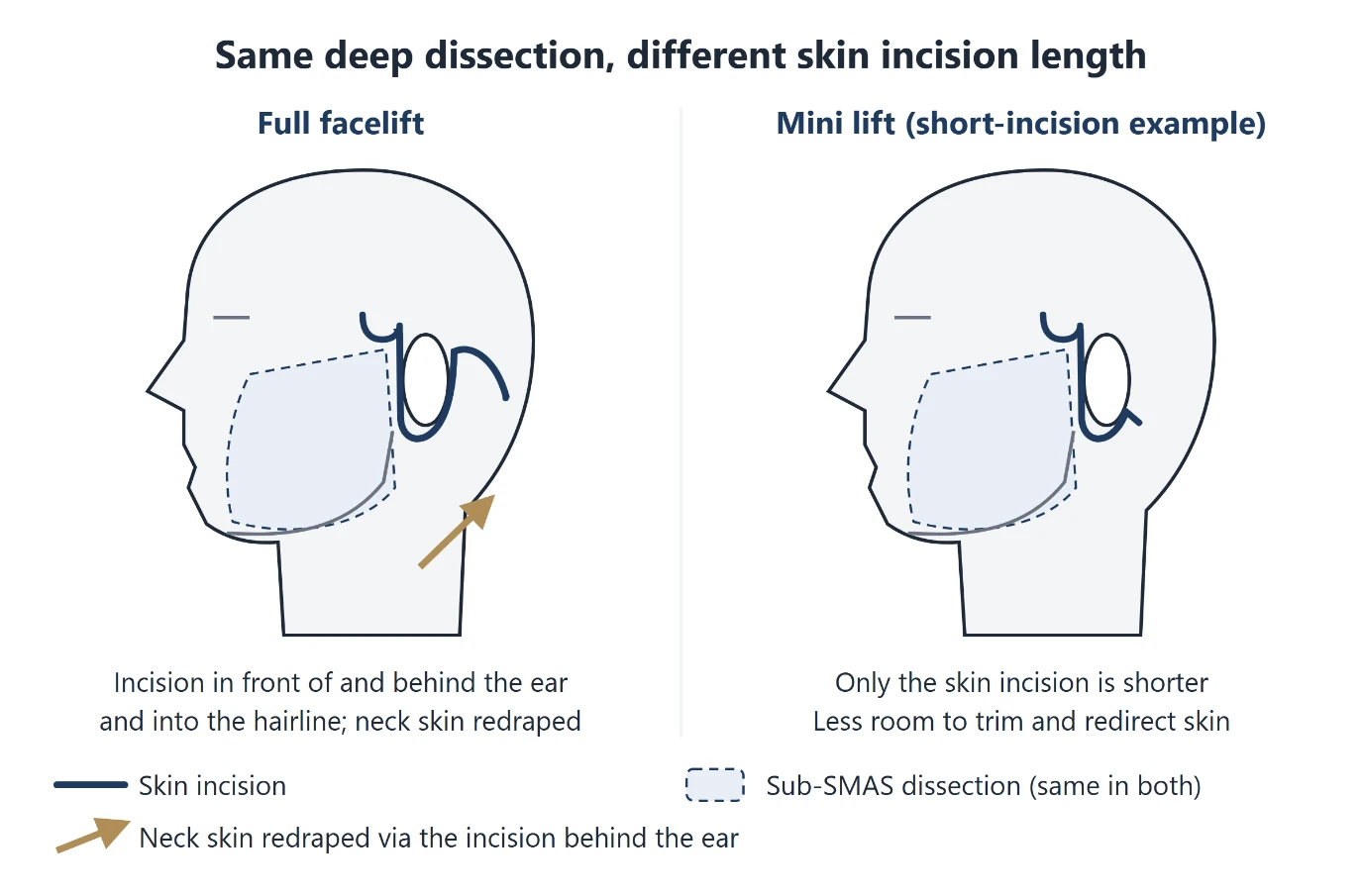
▲ Side-view comparison of skin incision lengths between a full facelift (extending from below the sideburn, in front of the ear, behind the ear, and along the occipital hairline) and AVA's short-incision mini facelift (from below the sideburn along the front of the ear to just behind the lower earlobe): while the sub-SMAS dissection extent is identical, the difference lies in skin excision capacity and neck skin redraping.
When a Mini Facelift Is a Good Fit (Indications)
1. When sagging is concentrated in the midface, cheeks, and around the mouth, with little neck sagging below the jawline [1][2]
2. When skin elasticity is relatively well preserved, leaving only a modest amount of excess skin to trim [1][2]
3. When minimizing incision length and downtime is a priority, and you understand the corresponding limit on neck skin redraping
When a Full Facelift Is Recommended (Indications)
1. When jowls have descended significantly below the mandibular border and blurred the jawline [1][2]
2. When loose, sagging neck skin has obscured the boundary between the jaw and the neck [2][3]
3. When significant skin laxity requires excising and redraping a substantial amount of redundant skin [1][2]
4. When prior lifting procedures or surgeries require addressing internal scar tissue and existing incisions simultaneously
Clinical Checkpoint | Closer to a Mini Facelift | Closer to a Full Facelift |
|---|---|---|
Jowls | Mild to moderate | Descended below the jawline [1][2] |
Neck Sagging | Minimal (well-defined neckline) | Pronounced neck laxity or wrinkles [2][3] |
Excess Skin | Minimal (good skin elasticity) | Substantial (requires wide skin excision) [1][2] |
Midface Sagging | Mild to moderate (lifted via sub-SMAS dissection) | Accompanied by lower-face & neck laxity [1][2] |
This table serves as a general clinical guide; during an in-person consultation, skin thickness, bone structure, and soft-tissue mobility are evaluated together.
How Is Midface Sagging Addressed by a Mini Lift vs. a Full Facelift?
Midface sagging—where descended cheek tissue below the cheekbone makes the nasolabial fold look heavy—depends far more on how widely and in what vector the deep SMAS layer is dissected and lifted than on the length of the skin incision [1]. Therefore, if midface and cheek sagging are your main concern and you do not have significant neck laxity or excess skin, a mini facelift with full sub-SMAS dissection can be an effective option.
Conversely, if midface sagging is accompanied by heavy jowls, neck laxity, and abundant excess skin, a full facelift utilizing the retroauricular incision is the more natural choice to maintain harmony across the entire face and neck [1][2]. Lifting only the upper/mid-face while leaving a lax jawline and neck behind can create an unnatural transition.
What Does Identical-Twin Research Say About Short-Scar vs. Full-Incision Facelifts?
A landmark study compared 11 sets of identical twins and triplets in which one twin underwent a full-incision facelift and the other underwent a short-scar (mini) facelift. At roughly 1 year postoperatively, facial and neck outcomes were comparable between the two groups, but at the 5-year long-term follow-up, the full-incision facelift was rated significantly superior in the neck region [3].
While the sample size of 11 twin sets is relatively small and the authors cautiously noted that a full incision "may" offer better long-term neck stability [3], the finding that the limitation of a short incision appears first in the neck is an important clinical factor we always discuss during consultation.
What Matters More Than Chronological Age When Choosing a Facelift?
Patients frequently ask, "At what age do I need a full facelift instead of a mini lift?" What matters far more than chronological age is where the sagging is located, how much excess skin must be removed, and the condition of your neck [1][4]. Two patients of the exact same age may require different procedures depending on skin thickness, elasticity, weight fluctuations, and prior aesthetic treatments.
If you have previously had thread lifts, dermal fillers, fat grafting, or facial bone contouring, please let us know during your consultation, as prior procedures affect tissue planes and dissection planning. Revision facelift surgery is covered in a separate column.
AVA Plastic Surgery's mini facelift keeps the skin incision short—running from below the sideburn along the front of the ear to just behind the lower earlobe—while maintaining the exact same sub-SMAS dissection extent as a full facelift to effectively lift sagging in the cheeks, mouth corners, and jawline. When neck sagging or submental laxity is the primary concern, we approach it with a dedicated neck lift or a full facelift rather than a mini facelift.
Final Thoughts: Matching Incision Length to Your Tissue Laxity
A smaller incision is not always insufficient, and a longer incision is not always necessary. The key is identifying where your facial sagging is concentrated and whether a short incision can smoothly redrape the excess skin without tension. That assessment is made most accurately during an in-person examination where the surgeon gently mobilizes your facial and neck skin.
Key Takeaways: Mini Facelift vs. Full Facelift
Here is a summary of the anatomical criteria separating a mini facelift from a full facelift.
Topic | Key Point |
|---|---|
What "Mini" Means | Different clinics use the term for very different procedures, so verify whether and how far the sub-SMAS layer is dissected [1][2]. |
AVA Plastic Surgery's Mini Lift | Designs a short skin incision from below the sideburn along the front of the ear to just behind the lower earlobe, while keeping the sub-SMAS dissection extent identical to a full facelift. |
Limits of a Short Incision | The amount and direction of skin removal are restricted, and without a full retroauricular incision behind the ear, loose neck skin cannot be fully redraped [1][2][3]. |
When a Mini Lift Fits Well | When sagging is focused in the cheeks, mouth corners, and mild jawline laxity, with minimal neck sagging and little excess skin [1][2]. |
When a Full Facelift Is Recommended | When jowls hang below the jawline, neck skin is loose, excess skin is abundant, or previous procedures must be addressed [1][2][3]. |
Identical-Twin Study Findings | In 11 sets of twins/triplets, 1-year results were similar, but at 5 years the full-incision facelift scored significantly higher in the neck [3]. |
Core Decision Criteria | Rather than age, the location of sagging, amount of excess skin, and neck condition determine the right procedure [1][4]. |
At AVA Plastic Surgery, Dr. Seungsoo Kim personally oversees every case from consultation through surgery and recovery.
※ This article provides general medical information for educational purposes. Results, recovery and scarring vary between individuals, and every surgery carries risks such as bleeding, infection, swelling and asymmetry. Diagnosis and treatment decisions are made only through an in-person consultation.
References
1. Warren RJ, Aston SJ, Mendelson BC. Face lift. Plast Reconstr Surg. 2011;128(6):747e-764e.
4. American Society of Plastic Surgeons. Facelift.
Related Procedures
• Facelift

Dr. Seungsoo Kim · Board-Certified Plastic Surgeon, AVA Plastic Surgery (Seoul)

Frequently Asked Clinical Questions (FAQ)
Q. What is the main anatomical difference between a Mini Facelift and a Full Deep-Plane Facelift?
At AVA, both procedures use the same extent of deep dissection beneath the SMAS. The main difference is the length of the skin incision and the amount of excess skin and neck skin laxity that can be addressed. A shorter incision may suit limited skin redundancy and mild neck laxity; more extensive excess skin or neck laxity may require extending the incision behind the ear.
Q. Does a Mini Facelift only pull the skin, or does it also lift the SMAS layer?
The label mini facelift is not standardized. AVA’s approach dissects and fixes the SMAS over the same deep extent as a full facelift, then redrapes the skin separately through a shorter skin incision. Results and durability depend on tissue quality, the surgical plan and individual healing.
Q. How do recovery timelines and recommended stays in Seoul compare between a Mini and Full Facelift?
For a Mini SMAS Facelift with a shorter skin incision, sutures are removed on postoperative day 10 and international patients typically stay in Seoul for 11 to 12 days. A Full Dual-Deep Plane Facelift also has all sutures (pre-auricular, retro-auricular and scalp) removed on postoperative day 10, and an 11-to-14-day stay in Seoul is recommended.
Facelift consultation in Seoul, Korea
Visit AVA Plastic Surgery near Exit 4 of Sinsa Station, on Gangnam-daero in Seoul. Our clinic is on the 4th floor of Inseong Building, 603 Gangnam-daero, Seocho-gu. A facelift consultation covers your concerns, previous treatments and recovery plans, including arrangements for your stay in Korea.
Facelift surgery in KoreaMeet Dr. KimDirections to Sinsa Station clinicRequest a facelift consultation
Read the original Naver blog post ·
Recommended Related Columns by Dr. Seungsoo Kim
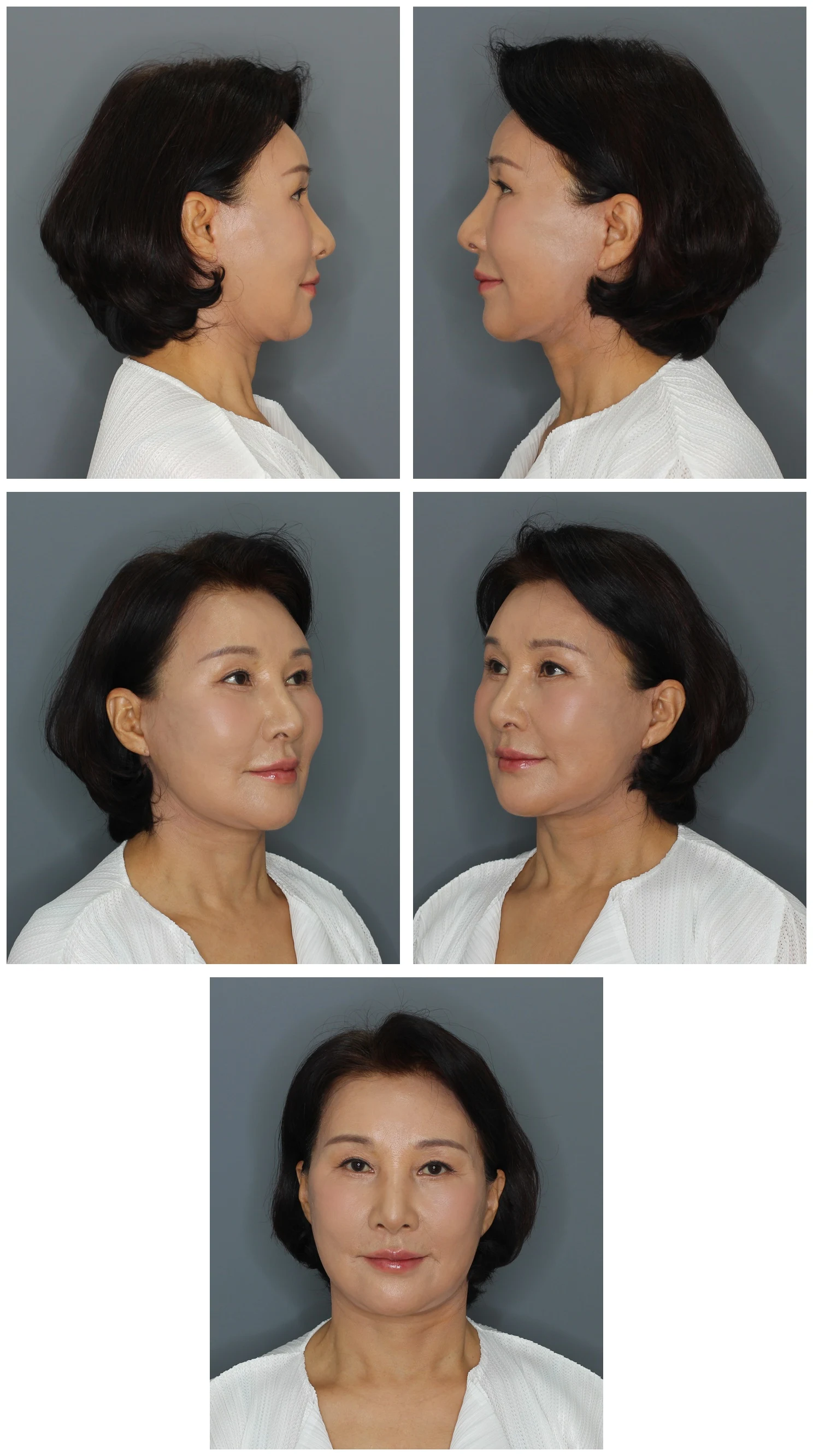
Why I Performed a Deep-Plane Facelift & Eyelid Surgery on My Own Mother — 2-Month Recovery Log
Read article →
Facelift Revision ① Pixie Ear. Why It Happens, and How to Correct It (Explained by a Plastic Surgeon)
Read article →
Facelift Revision ② Widened Scars: Why Cutting Out the Scar Alone Makes It Bigger
Read article →