SMAS, Deep Plane and Dual-Deep Plane: What Surgical Planes Mean
- Facelift technique names are defined by two anatomical variables: which tissue layer (dissection plane) is separated, and which structural layer carries the suspensory lifting tension.
- While SMAS plication or imbrication tightens fascia without wide sub-SMAS undermining, a deep-plane facelift enters the sub-SMAS glide space to release the zygomatic and masseteric cutaneous retaining ligaments so the anterior cheek and jawline can be repositioned.
- AVA Plastic Surgery's Dual-Deep Plane Facelift uses two dissection planes: within the subcutaneous layer and beneath the SMAS. The SMAS flap is lifted and fixed first, and the skin is redraped separately to minimize closure tension.
Planning a facelift in Seoul? Explore our Facelift in Korea: surgery, recovery and before-and-after cases.
SMAS Facelift, Deep Plane, and Dual-Deep Plane: What Surgical 'Planes' Actually Mean

"I heard the SMAS facelift is great, so what is a Deep Plane facelift?" "And how is a Dual-Deep Plane facelift different from a standard Deep Plane?" These are among the most common questions I hear during consultations. With so many different names and conflicting explanations online, the more you research, the more confusing it can get.
In reality, most facelift techniques are named after two things: which anatomical layer ('plane') is dissected, and which layer carries the lifting tension. Today, from a board-certified plastic surgeon's perspective, I will walk you through the layered anatomy of the face and explain exactly where a skin-only facelift, SMAS facelift, Deep Plane facelift, and AVA Plastic Surgery's Dual-Deep Plane facelift each stand.
How Are the 'Layers' of the Face Organized?
From the surface inward, the soft tissue of the face is organized into five main layers:
1. Skin (Epidermis and Dermis)
2. Subcutaneous Fat Layer
3. SMAS (Superficial Muscular Aponeurotic System) — a fibromuscular layer continuous with the muscles of facial expression
4. Sub-SMAS Space (Deep Plane) and Retaining Ligaments
5. Periosteum and Deep Fascia — branches of the facial nerve that control facial expressions course just along this deep floor.
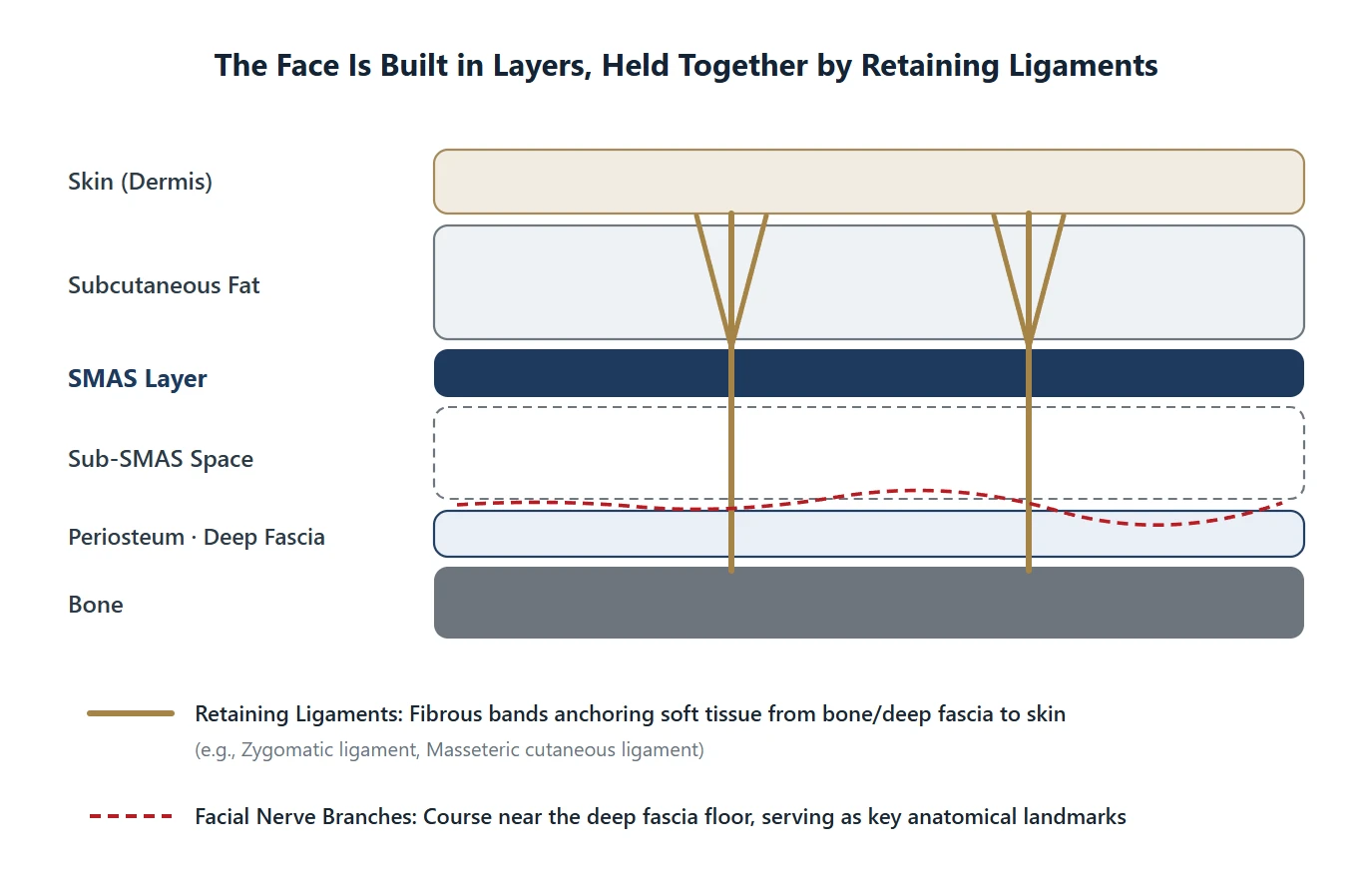
▲ Schematic diagram of the facial soft-tissue layers (skin, subcutaneous fat, SMAS, sub-SMAS space, periosteum and deep fascia), the retaining ligaments that anchor these layers to bone, and the facial nerve branches coursing near the deep fascia floor.
One structure you must understand here is the retaining ligament. Retaining ligaments are strong fibrous bands that originate from bone or deep fascia and extend upward into the dermis to hold facial soft tissues in place—most notably the zygomatic ligaments over the cheekbone and the masseteric cutaneous ligaments above the jawline. Because these ligaments divide facial fat compartments and lie close to facial nerve branches, they serve as critical anatomical landmarks for choosing the dissection plane and protecting the nerves during surgery[1]. (Exact ligament terminology and boundaries vary slightly across anatomical studies[1].)
Why Is a Skin-Only Facelift No Longer Enough?
Early facelifts simply elevated the skin in the subcutaneous fat layer, pulled the skin tight, and trimmed the excess. While structurally simple, this approach leaves the deeper sagging layers untouched and places all the pulling tension directly on the skin itself.
Because skin is an elastic tissue that gradually stretches back out under tension, the lifting effect of a skin-only lift rarely lasts. Moreover, concentrating tension along the incision line can widen scars or pull the earlobe downward into a tethered 'pixie ear' deformity (which we cover in detail in a separate column).
Even Within 'SMAS Facelifts,' There Are Multiple Techniques
In the plastic surgery literature, techniques that tighten the SMAS layer are broadly grouped as follows[2]:
1. SMAS Plication: Folding and suturing the SMAS layer inward without dissecting underneath it.
2. SMASectomy / Imbrication: Excising a strip of SMAS and overlapping the edges with sutures to tighten the layer.
3. SMAS Flap: Elevating the SMAS from the underlying tissue as a separate flap, advancing it upward and backward, and anchoring it.
4. High SMAS: Raising the SMAS flap above the zygomatic arch so that the lift extends into the midface (covered in a separate column).
Techniques 1) and 2) do not require wide dissection beneath the SMAS, making them relatively straightforward and reasonable options when sagging is mild or mainly limited to the lateral cheek and jawline. However, because the deep retaining ligaments remain unreleased, their ability to mobilize tissue medial to the ligaments—such as the anterior cheek and nasolabial fold—can be limited.
A Standard Deep Plane Facelift 'Releases the Retaining Ligaments'
In a standard Deep Plane facelift, dissection begins in the subcutaneous fat layer just in front of the ear and then steps down continuously at a transition line (entry point) directly into the sub-SMAS plane to release key retaining ligaments such as the zygomatic and masseteric cutaneous ligaments[1][4]. Once the ligaments holding the anterior tissues are released, the anterior cheek and jawline can move freely together with the lateral face. Anterior to the entry point, the skin, subcutaneous fat, and SMAS remain attached as a single full-thickness unit (composite flap) that is pulled together and closed at the skin[4].
Because branches of the facial nerve run just beneath the sub-SMAS space, performing a Deep Plane dissection safely requires precise anatomical mastery of depth and boundaries. (Facial nerve safety is discussed in detail in another column.)
So Which Technique Lasts the Longest?
To be completely candid, medical science does not yet have a single definitive answer. A systematic review comparing facelift techniques found that direct head-to-head studies are scarce and the overall level of evidence is low, making it difficult to declare one technique universally superior in efficacy or safety[3]. Likewise, a comprehensive systematic review of SMAS techniques noted that most published studies are retrospective with varying follow-up periods, preventing a rigid ranking of long-term longevity[2].
That is why, rather than asking 'Which technique has the trendiest name?', I first evaluate 'In which anatomical layer, and around which retaining ligaments, did this patient's sagging originate?'
Technique | Primary Dissection Plane | Where Lifting Tension Is Applied |
|---|---|---|
Skin-Only Lift | Subcutaneous fat layer beneath the dermis | Skin only is pulled and sutured |
SMAS Plication / Excision | Subcutaneous fat layer (above SMAS) | SMAS folded or excised without sub-SMAS dissection |
SMAS Flap | Subcutaneous fat + partial sub-SMAS dissection | SMAS flap elevated and fixed, followed by skin closure |
Standard Deep Plane | Subcutaneous dissection stepping continuously into sub-SMAS plane (ligaments released) | Full-thickness composite flap (SMAS + fat + skin) pulled together and closed at skin |
Dual-Deep Plane | 2-plane dissection: Subcutaneous fat layer + Sub-SMAS layer (ligaments released) | SMAS layer between the two planes is pulled and fixed first; skin is redraped to match and closed without tension |
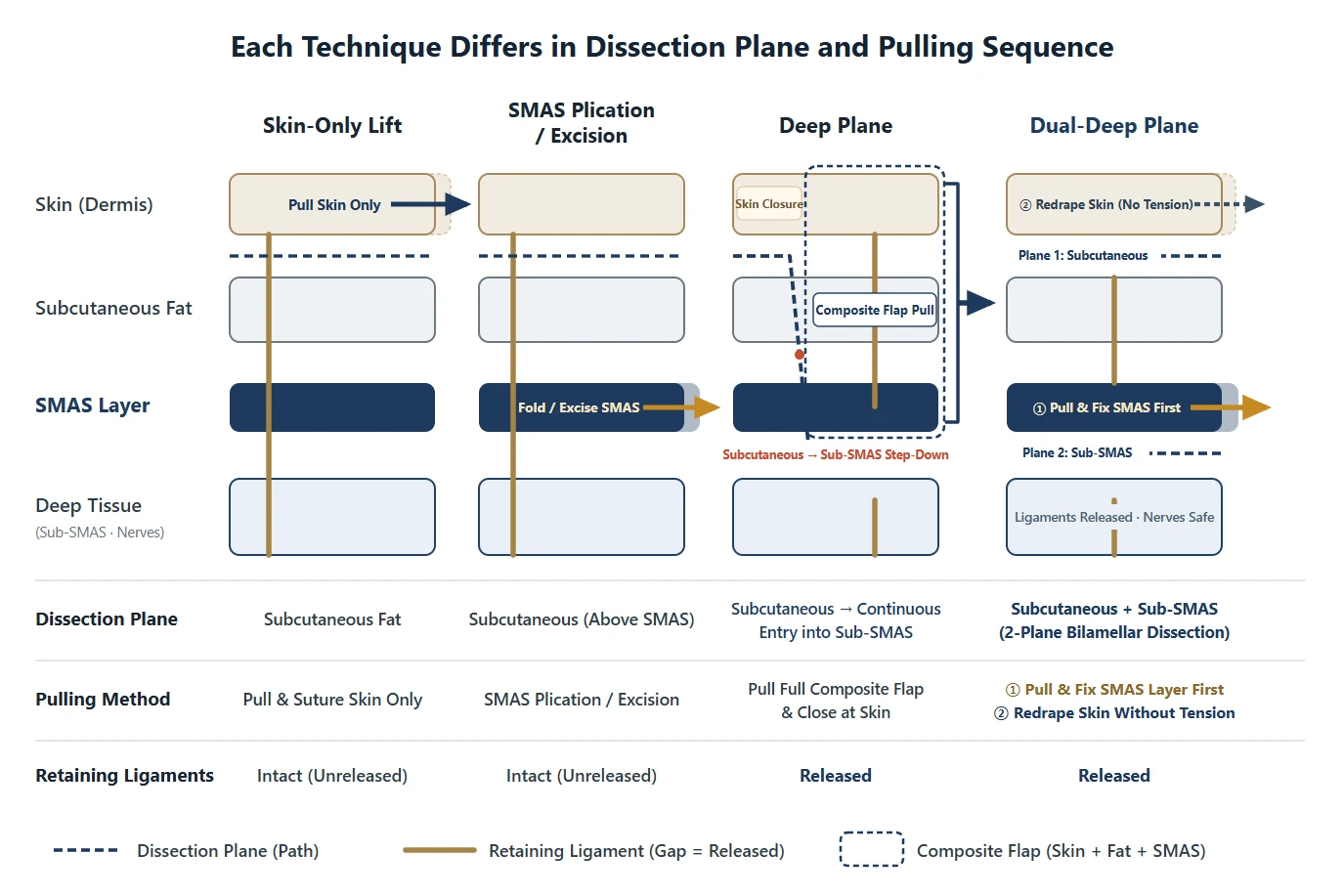
▲ Comparison diagram of a Skin-Only Lift, SMAS Plication/Excision, Standard Deep Plane (stepping from subcutaneous fat into the sub-SMAS plane to pull the composite flap as one unit), and Dual-Deep Plane (2-plane dissection of both the subcutaneous fat and sub-SMAS layers, pulling and anchoring the SMAS first and redraping skin without tension).
Where Does the 'Dual-Deep Plane' Facelift Fit In?
Rather than stepping directly from a short subcutaneous flap into the sub-SMAS space and pulling all layers as a single block like a standard Deep Plane lift, AVA Plastic Surgery's Dual-Deep Plane facelift applies a 2-plane (bilamellar) dissection principle—separately dissecting both the subcutaneous fat layer beneath the dermis and the sub-SMAS plane[4][5].
1. After performing this 2-plane dissection in the subcutaneous fat layer and sub-SMAS space and releasing the retaining ligaments, we first pull and firmly anchor the mobilized SMAS layer between the two dissection planes against gravity[5].
2. Second, we independently redrape a wider area of skin over the newly elevated SMAS contour and close the incisions with zero tension[4][5].
3. Because the SMAS lifting vector and the skin redraping vector can be adjusted independently to match each patient's facial contours, the skin settles smoothly without bunching, and incisions remain hidden along the natural curves in front of and behind the ear and along the hairline.
Why we separate the skin and SMAS into two planes—pulling SMAS first and redraping skin without tension—and how this directly improves scar quality and natural facial expression are covered in detail in our column 'Why Separating Skin Tension from SMAS Tension Changes Your Scar.' Because 2-plane dissection covers both planes, expected early swelling and recovery timelines based on your tissue thickness are explained thoroughly during consultation.
What Matters More Than the Name of a Technique
SMAS facelifts, Deep Plane facelifts, and Dual-Deep Plane facelifts are not competing brand names—they are different surgical solutions for handling specific layers of the face. A simpler approach may be ideal for mild laxity, whereas sagging that extends past the retaining ligaments into the midface calls for a deeper, multi-plane approach. Before choosing a technique by name, the most important first step is an accurate diagnosis of which layers are driving your facial aging.
Summary at a Glance
Key takeaways from today's guide, organized by question.
Question | Key Takeaway |
|---|---|
How are facelift techniques categorized? | By which anatomical layer (plane) is dissected and which layer carries the lifting tension. |
What is the limitation of a skin-only facelift? | Putting tension directly on the skin leads to early stretching, wider scars, or a pulled earlobe (pixie ear). |
What about SMAS plication or excision? | A streamlined option suitable for mild lateral cheek or jawline laxity, though unreleased retaining ligaments can limit anterior cheek and nasolabial improvement. |
What is a standard Deep Plane facelift? | A surgery that dissects in the subcutaneous fat layer, steps continuously into the sub-SMAS plane to release retaining ligaments, and pulls the full-thickness composite flap together to close at the skin. |
What is a Dual-Deep Plane facelift? | A 2-plane dissection in both the subcutaneous fat layer beneath the dermis and the sub-SMAS layer: the SMAS layer between the two planes is pulled and fixed first, and a wider skin flap is then redraped to match and sutured without tension. |
Which technique lasts the longest? | High-quality head-to-head comparative studies are limited, so no single technique can be declared universally longest-lasting for every patient. |
What should I check first? | Rather than focusing on the name alone, start with an accurate diagnosis of which facial layer and retaining ligaments are causing your sagging. |
At AVA Plastic Surgery, Chief Director Dr. Seung-Soo Kim personally handles every step from consultation and surgery to recovery.
※ This article provides general medical information for educational purposes. Surgical results, recovery timelines, and scar appearance vary by individual, and all surgeries carry potential risks including bleeding, infection, swelling, and asymmetry. An in-person consultation is required for an accurate diagnosis and treatment plan.
References
4. Warren RJ, Aston SJ, Mendelson BC. Face lift. Plast Reconstr Surg. 2011;128(6):747e-764e.
5. Stuzin JM, Baker TJ, Gordon HL, Baker TM. Extended SMAS dissection as an approach to midface rejuvenation. Clin Plast Surg. 1995;22(2):295-311.
Related Procedures
• Facelift

Seung-Soo Kim, MD · Board-Certified Plastic Surgeon, Chief Director

Frequently Asked Clinical Questions (FAQ)
Q. What is the anatomical difference between a skin-only facelift, an SMAS facelift, and a deep-plane facelift?
A skin-only facelift undermines only subcutaneous fat and pulls the skin envelope, which can stretch over time and place excessive tension on the ear incision (increasing the risk of widened scars or pixie-ear deformity). SMAS facelifts tighten the Superficial Muscular Aponeurotic System via folding (plication), partial strip excision (SMASectomy/imbrication), or elevating an SMAS flap. A deep-plane facelift enters the sub-SMAS space and releases the retaining ligaments (such as the zygomatic and masseteric cutaneous ligaments) that tether sagging midface and jawline soft tissue.
Q. How does AVA's Dual-Deep Plane Facelift differ from a traditional composite deep-plane facelift?
A traditional deep-plane facelift typically elevates the skin and SMAS together as a composite unit after releasing the retaining ligaments. AVA Plastic Surgery's Dual-Deep Plane approach uses two dissection planes, within the subcutaneous layer and beneath the SMAS. The intervening SMAS flap, including some subcutaneous fat, is advanced and fixed first; the skin is then redraped separately with minimal closure tension. Two dissection planes should not be confused with the tissue layers separated by them.
Q. Does clinical literature prove that one facelift plane always lasts longer, and what surgical risks must be considered?
Published systematic reviews note that head-to-head comparative studies have heterogeneous follow-up periods, meaning no single named technique is universally superior for every patient. Instead, surgical selection should match the specific anatomical layer and retaining ligaments where your laxity originates. Because facial nerve branches course near the deep sub-SMAS plane and retaining ligaments, surgery requires thorough anatomical precision; potential risks include bleeding, hematoma, infection, swelling, contour irregularity, asymmetry, scarring, sensory changes, or temporary/rare facial nerve weakness, and recovery varies by individual.
Facelift consultation in Seoul, Korea
Visit AVA Plastic Surgery near Exit 4 of Sinsa Station, on Gangnam-daero in Seoul. Our clinic is on the 4th floor of Inseong Building, 603 Gangnam-daero, Seocho-gu. A facelift consultation covers your concerns, previous treatments and recovery plans, including arrangements for your stay in Korea.
Facelift surgery in KoreaMeet Dr. KimDirections to Sinsa Station clinicRequest a facelift consultation
Read the original Naver blog post ·
Recommended Related Columns by Dr. Seungsoo Kim

Facelift and Neck Wrinkles: Platysma, Submentoplasty and Liposuction
Read article →
High SMAS vs Low SMAS: Midface and Nasolabial Fold Improvement
Read article →
Neck Lift (Platysmaplasty) vs. Double-Chin Liposuction — Bands, Deep Fat & Neck Lines
Read article →