Nasolabial Folds: Should You Fill with Filler or Lift Back into Place? (3-Stage Guide)
- Nasolabial folds stem from two distinct mechanisms: bony pyriform aperture depression vs. descent of the malar fat pad and SMAS.
- Injecting heavy filler into a fold caused by midface ptosis adds weight above the mouth and can create a puffy, unnatural smile.
- Releasing the zygomatic and maxillary retaining ligaments during a deep-plane lift repositions the descended cheek pad at its source.
Planning a facelift in Seoul? Explore our Facelift in Korea: surgery, recovery and before-and-after cases.
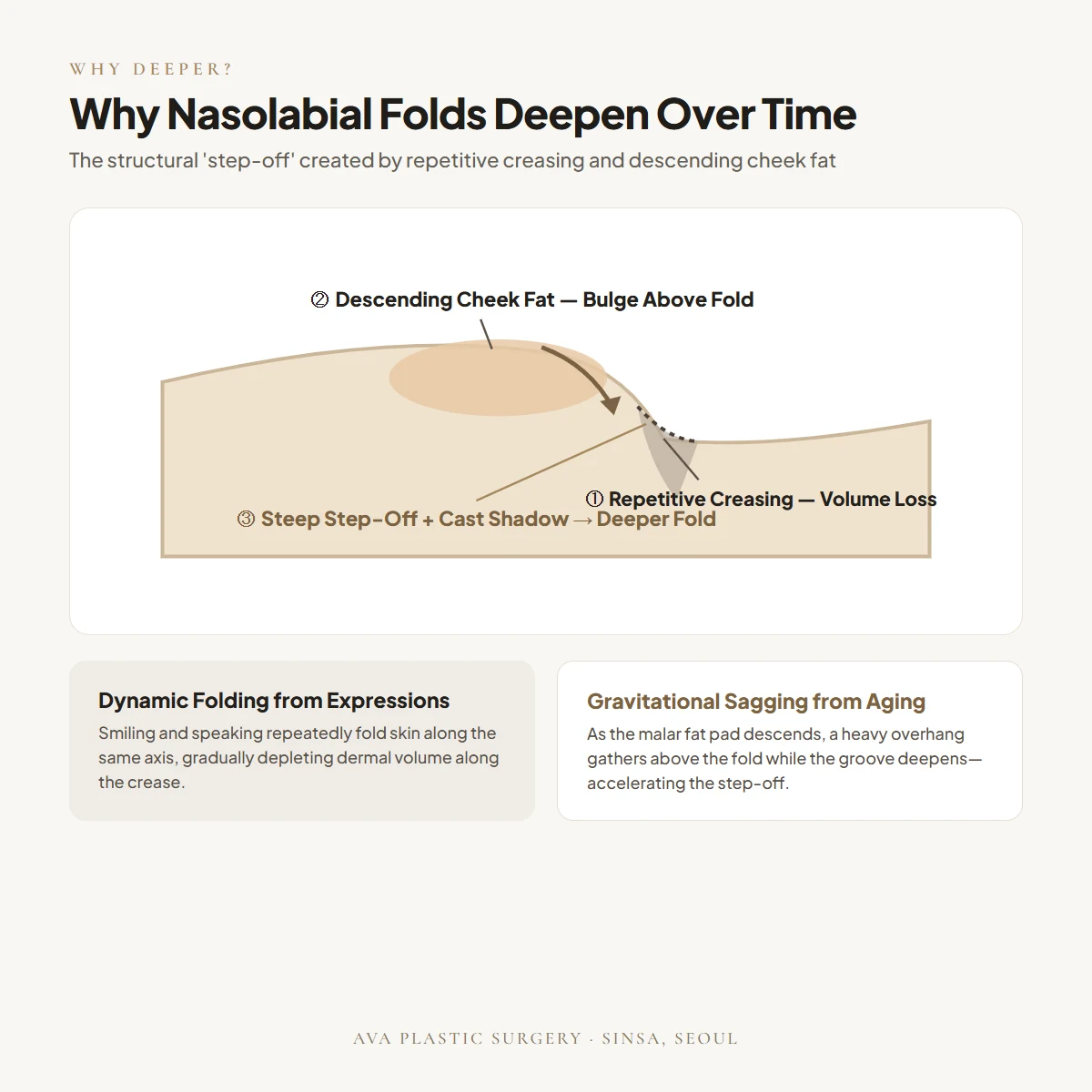
1. Why Nasolabial Folds Deepen: Dynamic Folding Meets Cheek Fat Descent
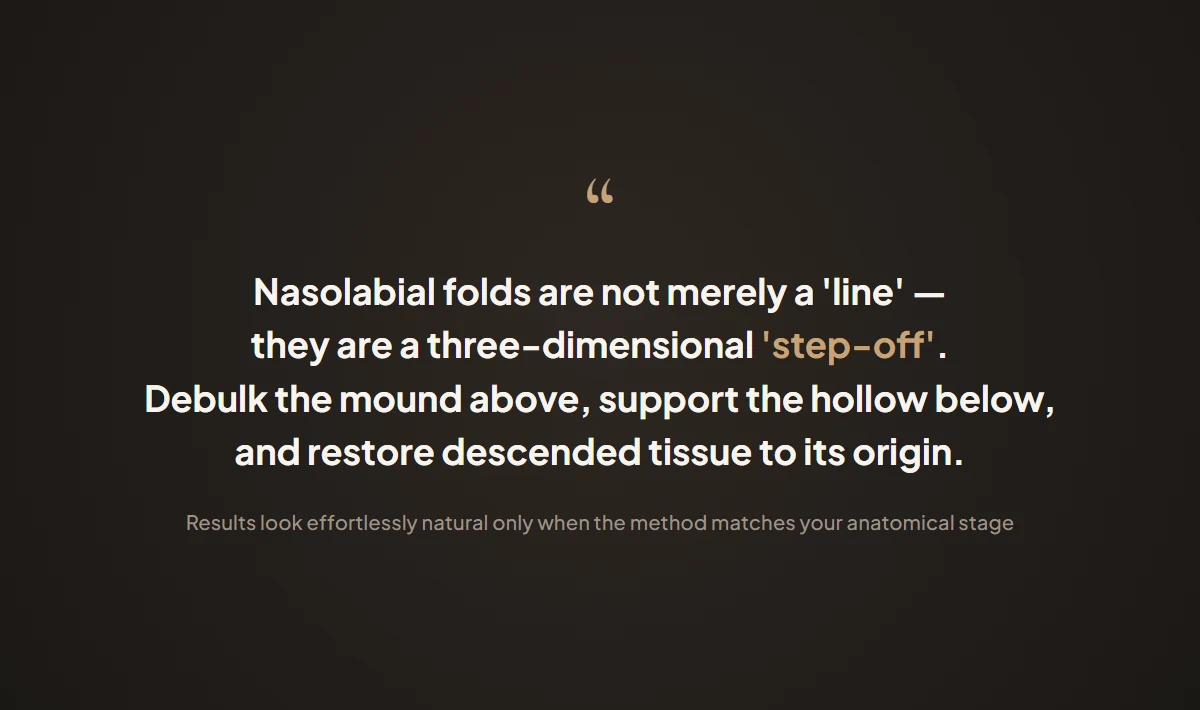
Nasolabial folds form through two combined mechanisms: repetitive creasing from thousands of daily smiles and words (which thins dermal volume along the crease), and gravitational descent of the malar (mid-cheek) fat pad. As cheek fat slides downward, it piles up as a heavy mound directly above the fold, turning a gentle crease into a steep three-dimensional step-off that casts a deep shadow.
2. Stage 1 — Intact Cheek Elasticity, Crease Groove Only: 'Targeted Filling'
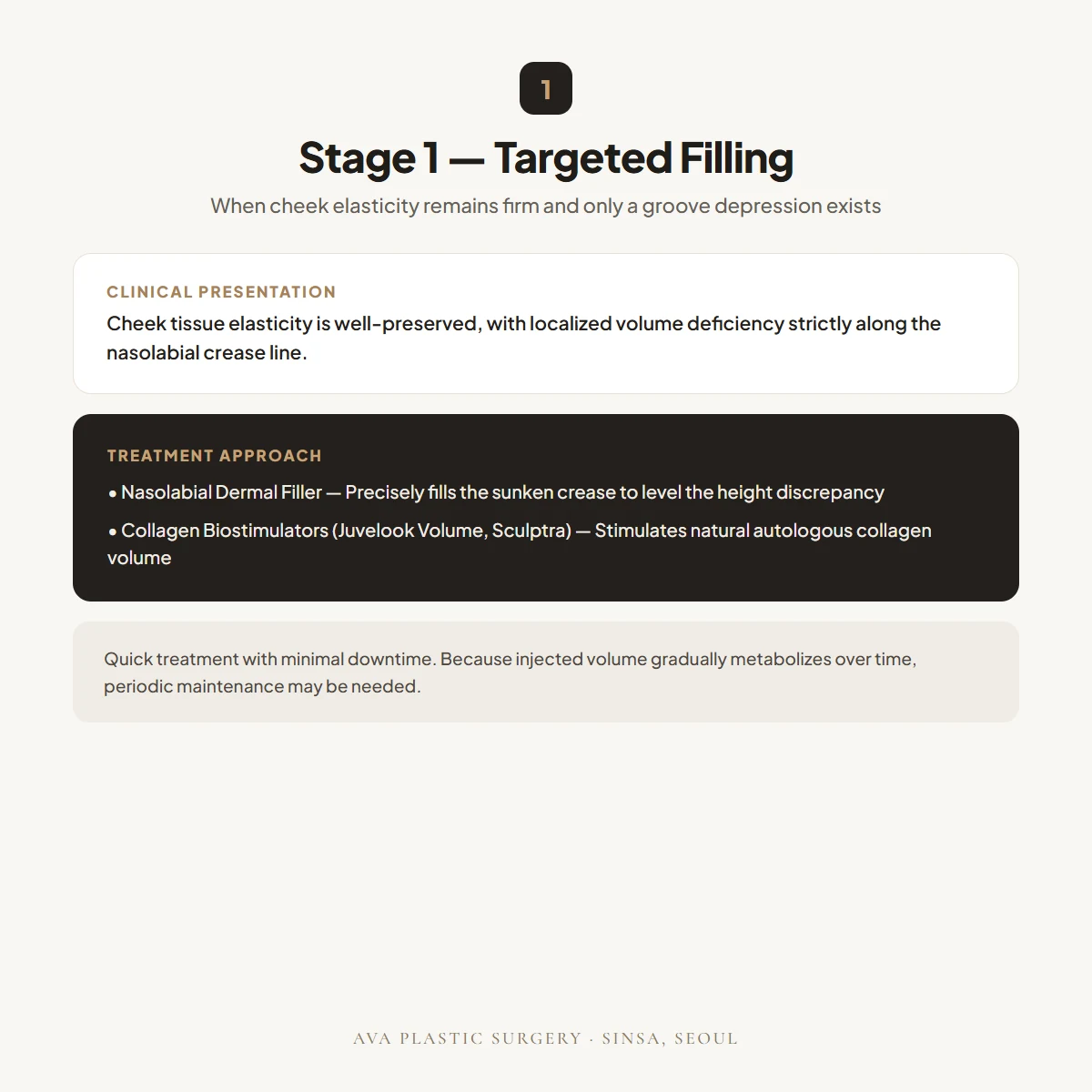
When mid-cheek elasticity is still firm and only a localized volume trough exists along the fold line, targeted hyaluronic acid filler or collagen biostimulators (such as Juvelook Volume or Sculptra) smoothly level the step-off with minimal downtime.
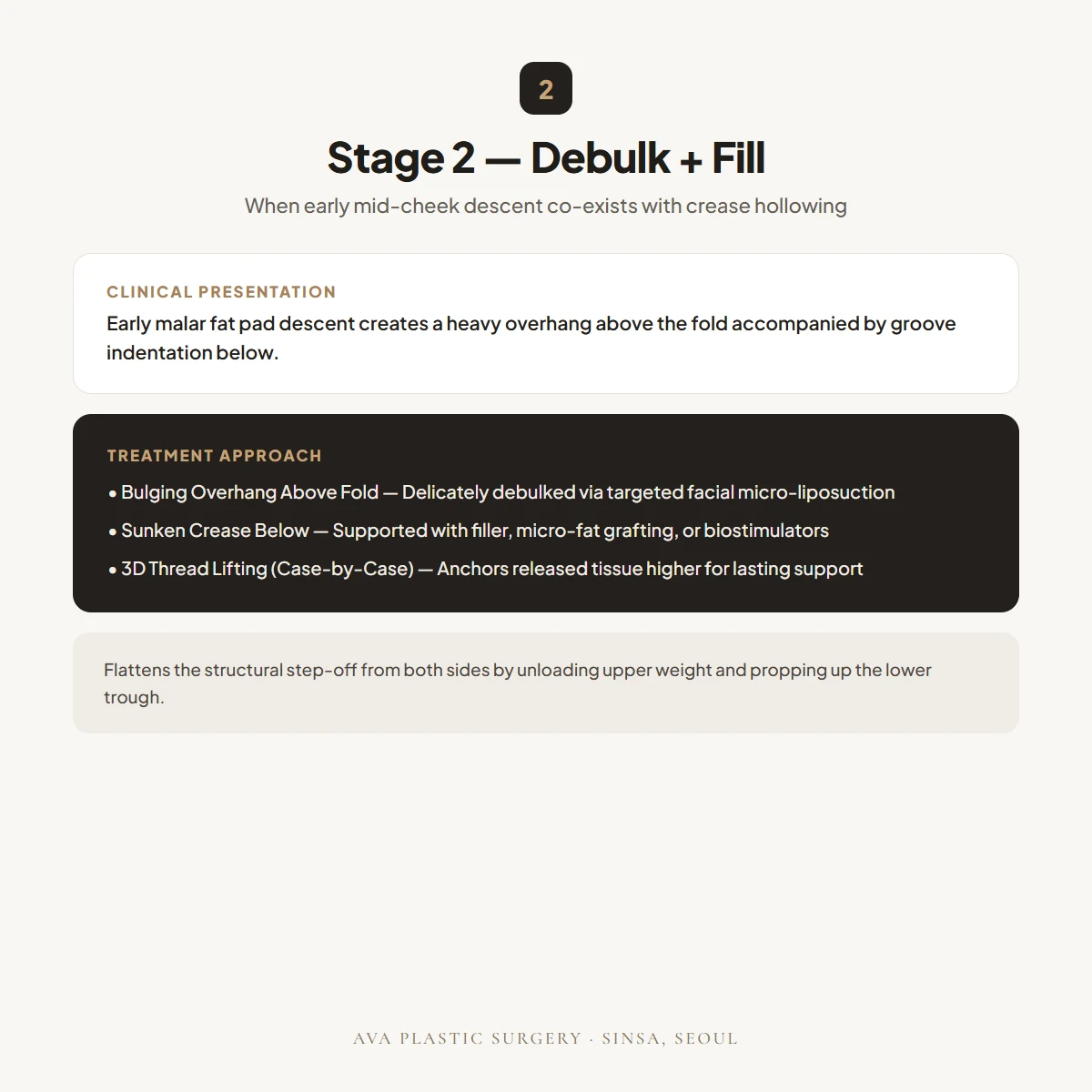
3. Stage 2 — Early Cheek Descent + Deepened Groove: 'Debulk Above + Fill Below'
Once the cheek fat pad begins overhanging the fold, injecting filler alone makes the midface look heavy and unnatural. Instead, we debulk the heavy fat mound above the fold via targeted micro-liposuction, support the sunken groove below with filler or micro-fat grafting, and add 3D thread lifting when indicated.
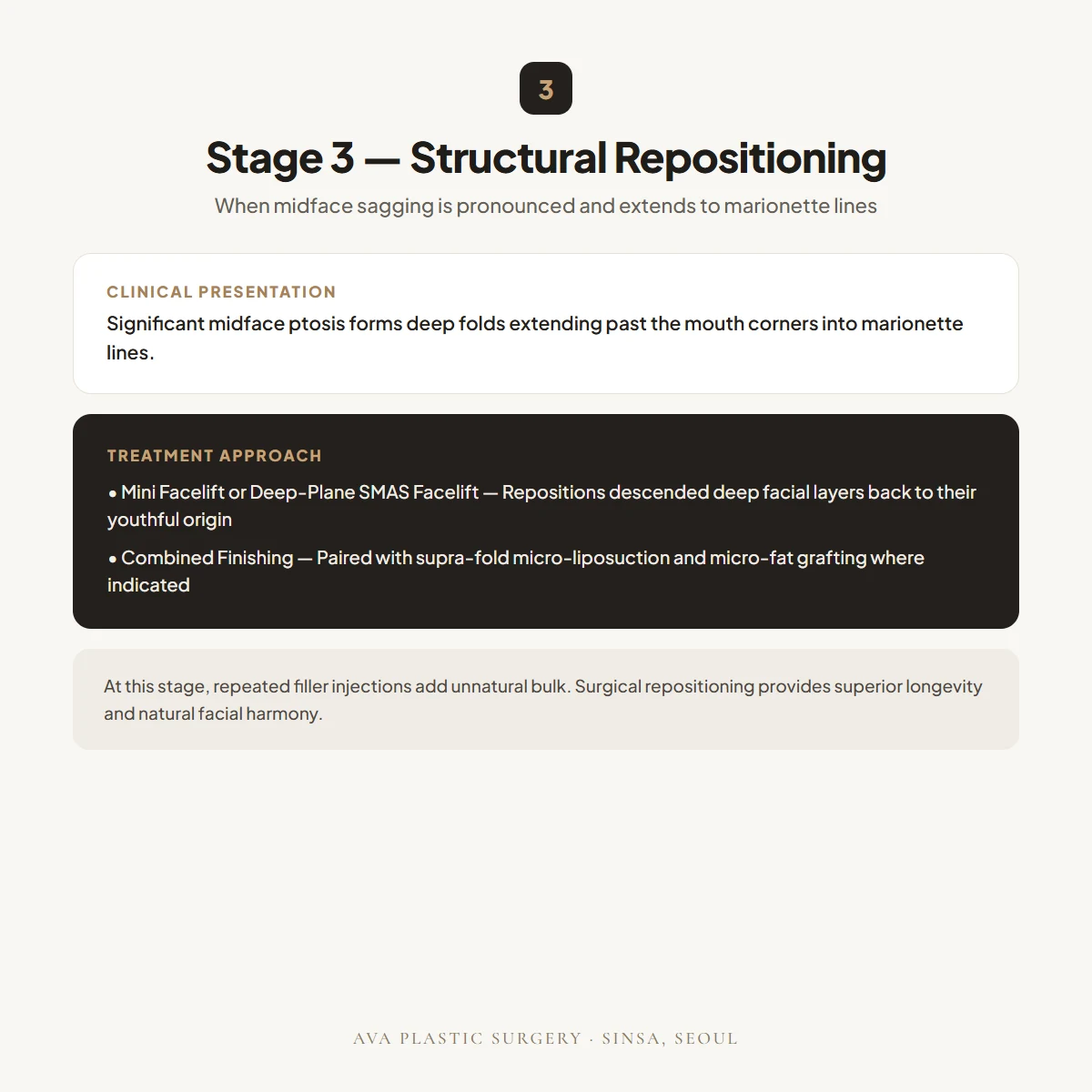
4. Stage 3 — Pronounced Midface Sagging & Marionette Lines: 'Structural Lifting'
When sagging extends past the mouth corners into marionette lines, repeated filler injections yield diminishing returns. At this stage, a Mini Facelift or Deep-Plane SMAS Facelift anatomically repositions the descended deep tissues back to their youthful coordinates—often paired with supra-fold liposuction or micro-fat grafting for complete harmony.
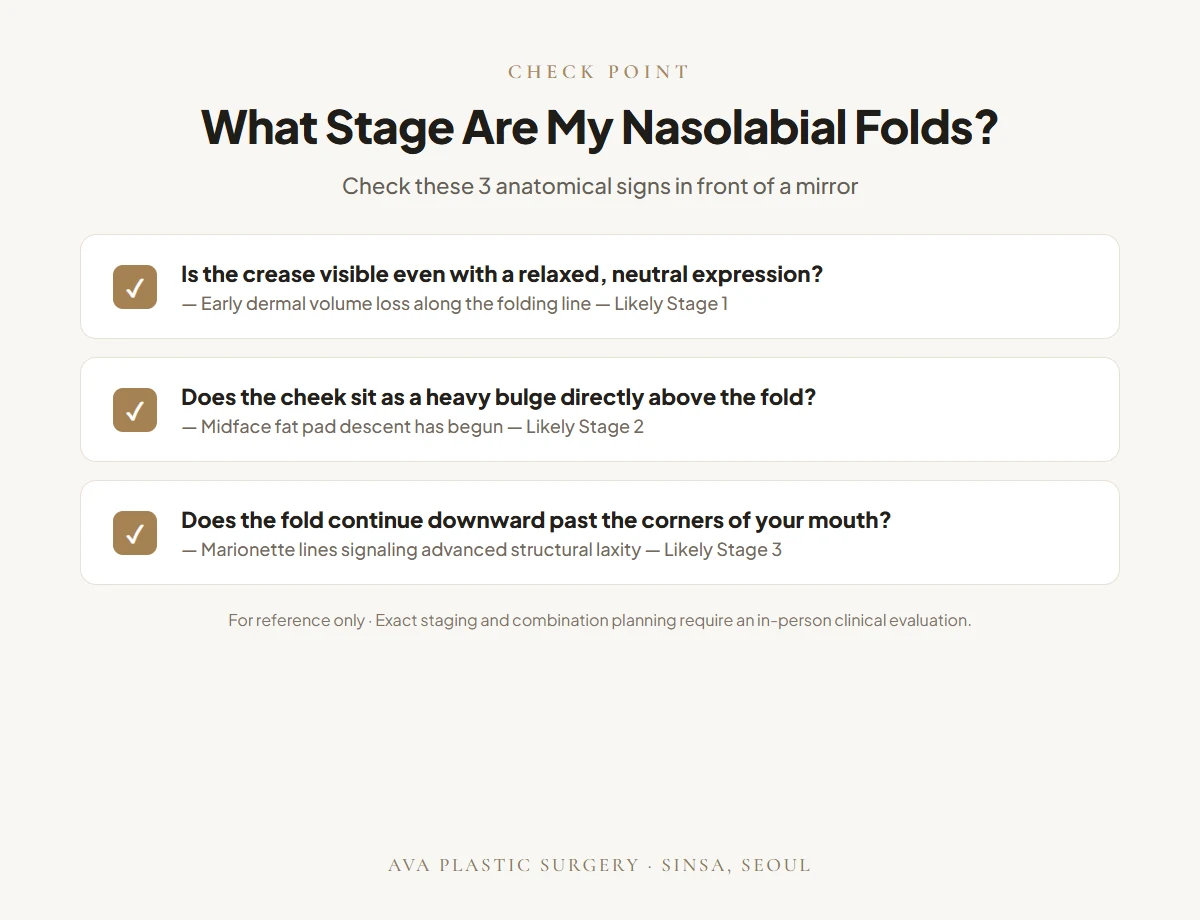
5. Mirror Self-Check: What Stage Are Your Nasolabial Folds?
Book Your 1:1 Consultation with Dr. Seungsoo Kim
Whether you are flying in from overseas or living in Korea, Dr. Seungsoo Kim personally oversees every step from initial consultation to surgery and recovery:
- 📅 Book a 1:1 Zoom Video Pre-Consultation or Seoul Clinic Visit (English Booking Hub) →
- 📖 Read Dr. Kim's Mother's Deep-Plane Facelift & Eyelid Surgery 2-Month Recovery Log →
- ✨ View Deep-Plane Facelift Guide & 1-Year Follow-Up Cases →
- 👁️ View Upper Eyelid, Sub-Brow & Forehead Lift Guide →
- 💬 Chat Directly on WhatsApp (+82 10-3705-3423) →
📍 AVA Plastic Surgery · 4F Insung Building, 603 Gangnam-daero, Seocho-gu, Seoul (1-min walk from Sinsa Station Exit 4) · TEL +82 2-545-1882
※ Surgical & Consultation Notice: 1:1 Zoom video consultations provide a preliminary educational assessment; final surgical candidacy and operative plans are confirmed through an in-person clinical examination by Dr. Seungsoo Kim in Seoul. Post-operative complications such as bleeding, infection, swelling, scarring, asymmetry, or sensory changes may occur, and results and recovery vary by individual.
Frequently Asked Clinical Questions (FAQ)
Q. How can I tell if my nasolabial folds need filler or a lift?
If gently lifting your cheek upward and outward in a mirror flattens the fold, midface tissue descent is the primary driver and lifting is indicated. If a deep triangular hollow remains right beside the nostril even when lifted, volume restoration may help.
Q. Why can repeated nasolabial filler make the midface look heavy?
When the malar fat pad has sagged over the fold, adding filler into the crease increases bulk around the mouth and can migrate superiorly with smiling muscles.
Q. How does a deep-plane facelift improve nasolabial folds?
By releasing the zygomatic and upper masseteric retaining ligaments in the sub-SMAS plane, Dr. Kim elevates the descended malar fat pad back onto the cheekbone, unloading the heavy overhang above the fold.
Read the original Naver blog post ·
Recommended Related Columns by Dr. Seungsoo Kim
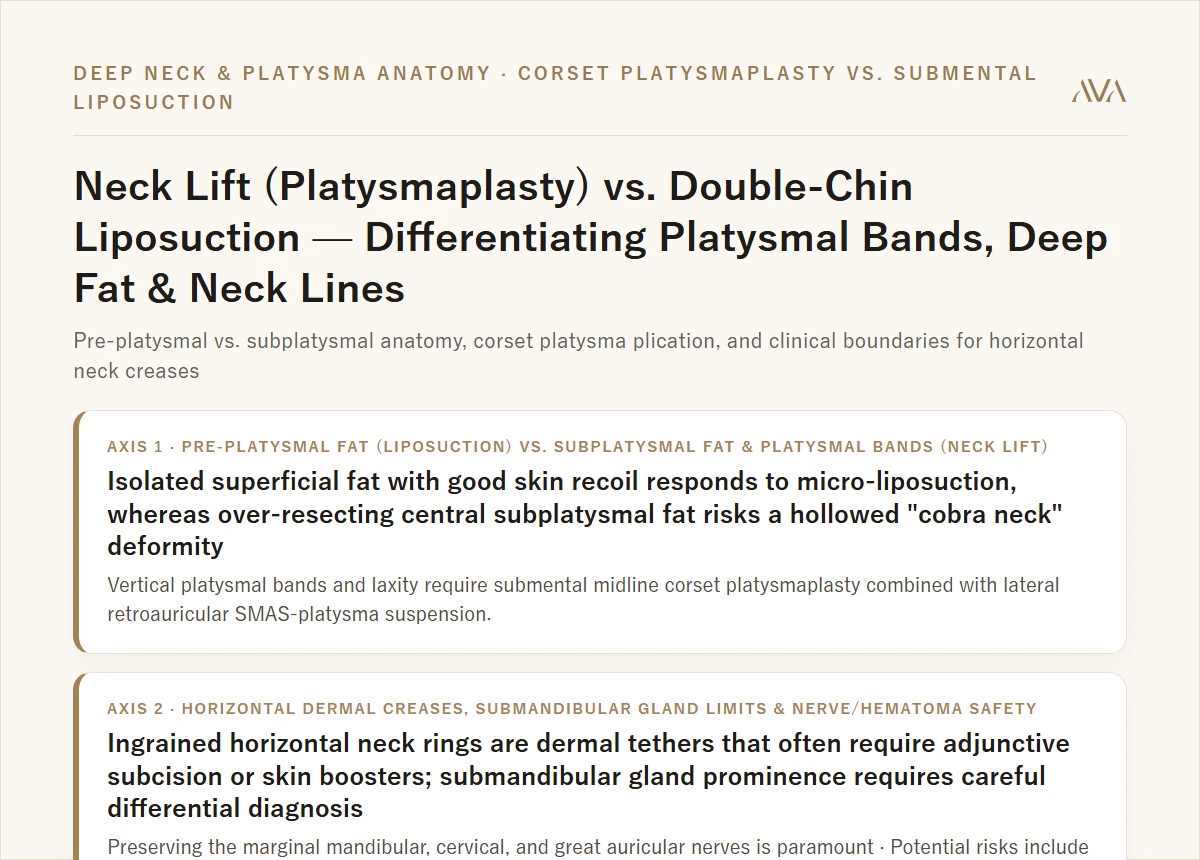
Neck Lift (Platysmaplasty) vs. Double-Chin Liposuction — Bands, Deep Fat & Neck Lines
Read article →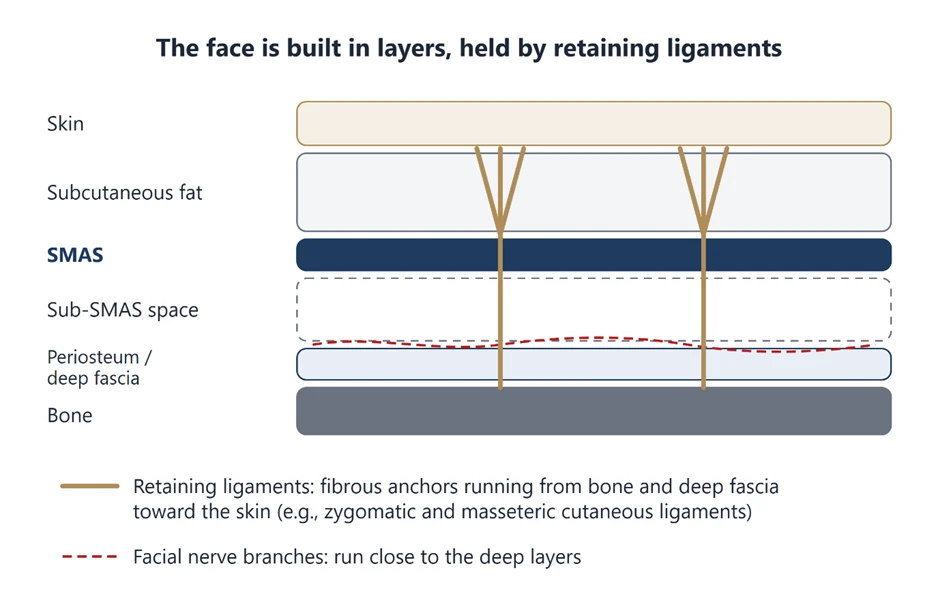
SMAS vs Deep Plane Facelift: What the "Plane" Really Means
Read article →
Facelift Scars: Where the Incision Goes Makes the Difference | AVA Plastic Surgery, Sinsa Station
Read article →