Ptosis Self-Check & Clinical Measurement — MRD1, Levator Function, and When to Correct
- True blepharoptosis (weak levator muscle) must be distinguished from pseudoptosis (hooded skin or brow descent covering a normal muscle).
- Clinical diagnosis relies on measuring Margin Reflex Distance 1 (MRD1) and levator excursion while stabilizing the brow.
- Precisely calibrating levator advancement restores effortless eye opening, reduces forehead strain, and prevents asymmetric creases.
Have you noticed your eyes looking sleepier in the mirror than they used to, or felt yourself subconsciously raising your eyebrows just to keep your eyes open?
While it is easy to assume that upper eyelid skin has simply sagged, the root cause is often blepharoptosis (ptosis)—a weakening of the levator muscle or aponeurosis that lifts the eyelid. Because skin laxity and muscle weakness require completely different corrections, accurate diagnosis comes first.
1. First, Distinguish the Three: True Ptosis, Skin Laxity, and Brow Descent
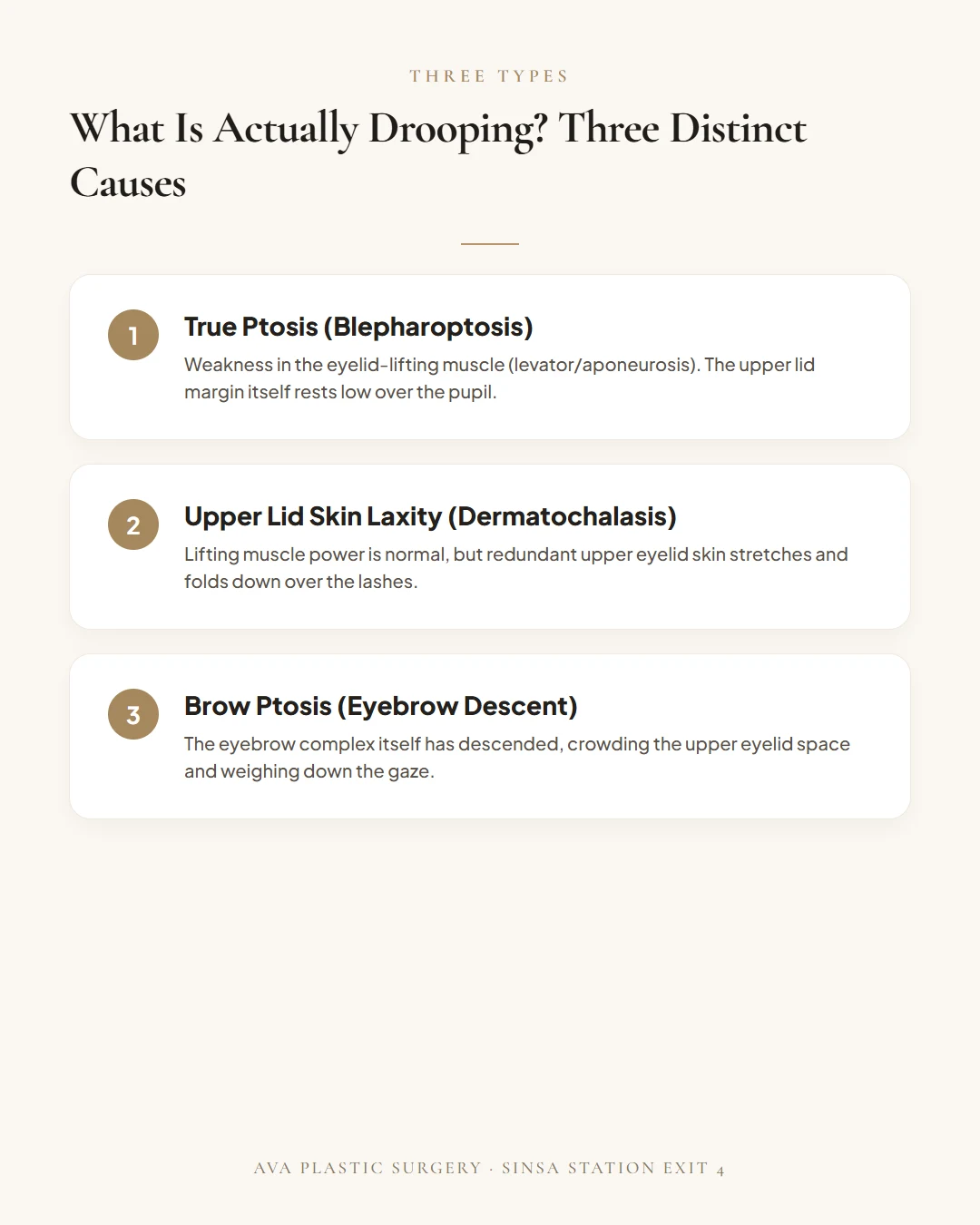
- True Ptosis (Blepharoptosis): Weakened eyelid-elevating power (levator muscle or aponeurosis). The upper lid margin rests lower over the pupil.
- Upper Lid Dermatochalasis (Skin Laxity): Lifting muscle power is intact, but redundant upper lid skin folds over the lashes.
- Brow Ptosis: The eyebrow itself descends, pressing down on the upper eyelid space.
2. 7-Point Home Self-Diagnostic Checklist
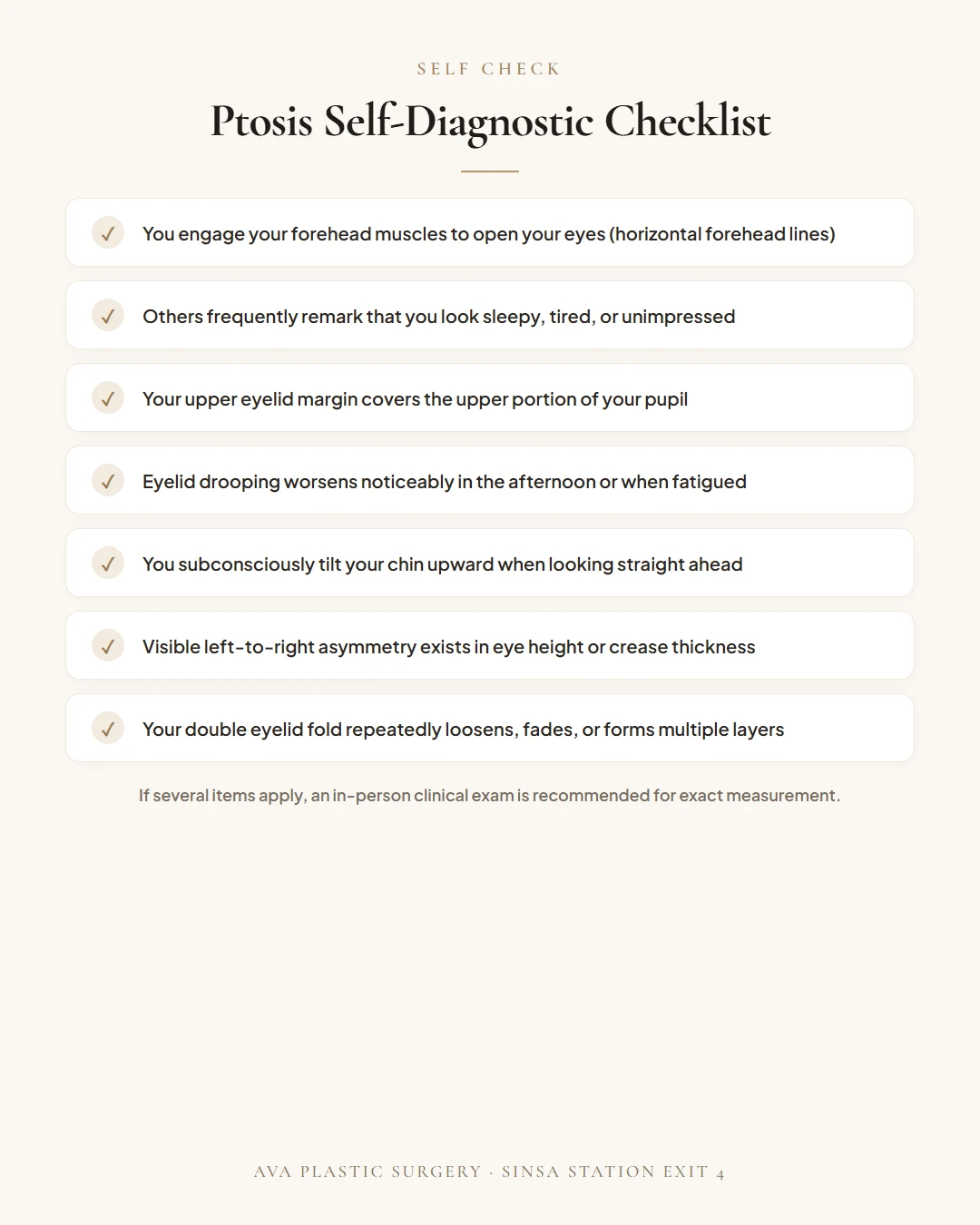
※ Note: If eyelid drooping worsens abruptly in the late afternoon accompanied by double vision (diplopia), systemic neuromuscular conditions (such as myasthenia gravis) should be ruled out first.
3. What We Measure in the Clinic: MRD1 & Levator Function
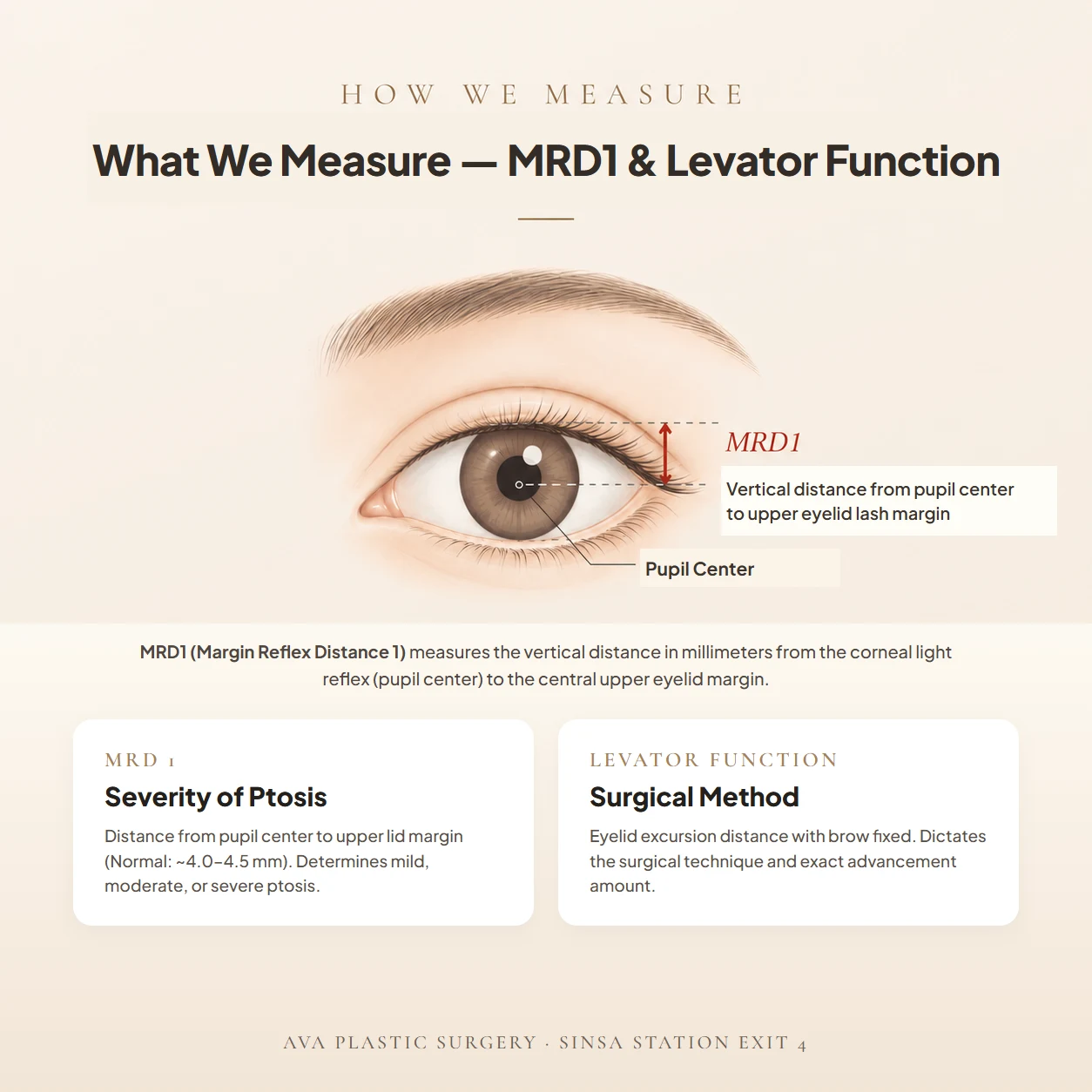
Ptosis correction never relies on guesswork. We measure two quantitative metrics with the forehead completely relaxed:
- MRD1 (Margin Reflex Distance 1) — Severity of Ptosis: The vertical distance from the corneal light reflex (pupil center) to the upper eyelid margin. Normal is roughly 4.0–4.5 mm.
- Levator Excursion — Surgical Method Selection: With the eyebrow held fixed to block forehead compensation, we measure how many millimeters the eyelid travels from extreme downgaze to upgaze. This dictates the exact technique and advancement amount.
"Ptosis correction is not about cutting away tissue; it is about measuring lifting power with exacting precision while the forehead is completely relaxed, and restoring only what is needed for balanced symmetry." — Dr. Seungsoo Kim

Book Your 1:1 Consultation with Dr. Seungsoo Kim
Whether you are flying in from overseas or living in Korea, Dr. Seungsoo Kim personally oversees every step from initial consultation to surgery and recovery:
- 📅 Book a 1:1 Zoom Video Pre-Consultation or Seoul Clinic Visit (English Booking Hub) →
- 📖 Read Dr. Kim's Mother's Deep-Plane Facelift & Eyelid Surgery 2-Month Recovery Log →
- ✨ View Deep-Plane Facelift Guide & 1-Year Follow-Up Cases →
- 👁️ View Upper Eyelid, Sub-Brow & Forehead Lift Guide →
- 💬 Chat Directly on WhatsApp (+82 10-3705-3423) →
📍 AVA Plastic Surgery · 4F Insung Building, 603 Gangnam-daero, Seocho-gu, Seoul (1-min walk from Sinsa Station Exit 4) · TEL +82 2-545-1882
※ Surgical & Consultation Notice: 1:1 Zoom video consultations provide a preliminary educational assessment; final surgical candidacy and operative plans are confirmed through an in-person clinical examination by Dr. Seungsoo Kim in Seoul. Post-operative complications such as bleeding, infection, swelling, scarring, asymmetry, or sensory changes may occur, and results and recovery vary by individual.
Frequently Asked Clinical Questions (FAQ)
Q. What is the difference between true eyelid ptosis and hooded eyelid skin (pseudoptosis)?
In pseudoptosis, the levator muscle functions normally but excess skin or a low brow hangs over the lashes. In true ptosis, the levator muscle or aponeurosis itself is weak or stretched, requiring levator advancement (ptosis correction).
Q. What happens if true ptosis is missed during standard double eyelid surgery?
Without tightening the levator mechanism, the eyelid still cannot open fully, leaving a wide, sleepy-looking crease and ongoing forehead muscle strain.
Q. How do you choose between non-incisional and incisional ptosis correction?
Non-incisional ptosis repair suits mild ptosis with thin, non-sagging eyelid skin; incisional ptosis repair is indicated when moderate-to-severe ptosis or excess skin and fat are present.
Read the original Naver blog post ·
Recommended Related Columns by Dr. Seungsoo Kim
Why Do Eyes Droop from the Outside First? Lateral Hooding and the Sub-Brow Lift
Read article →
Lower Blepharoplasty vs. Under-Eye Fat Repositioning — Why the Mid-30s Is the Dividing Line
Read article →
Under-Eye Fat Repositioning 101: Benefits, Transconjunctival Technique, Recovery & Precautions
Read article →